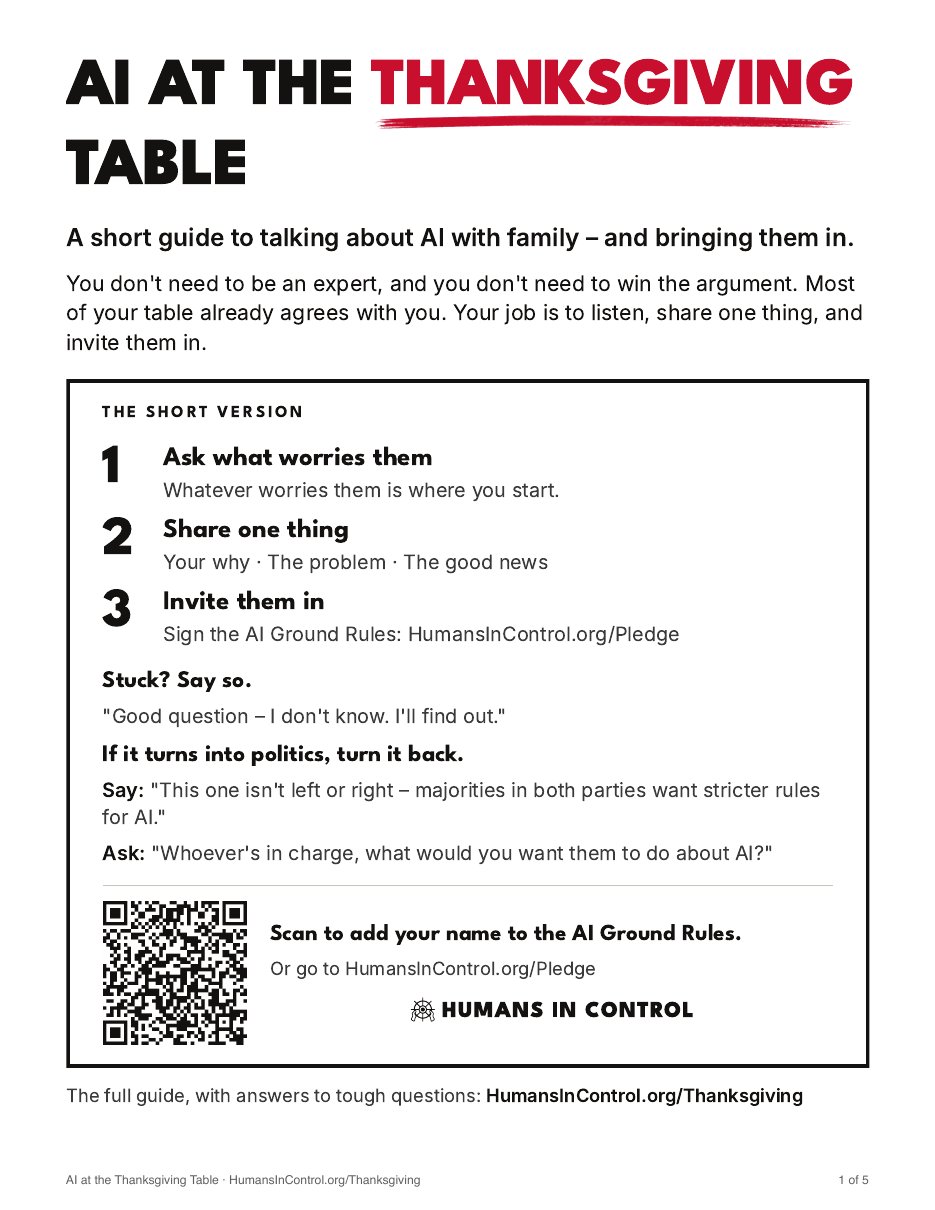
A short guide to talking about AI with family – and bringing them in.
You don't need to be an expert, and you don't need to win the argument. Most of your table already agrees with you. Your job is to listen, share one thing, and invite them in.
Print the guide (PDF)Part 1 of 2
Over dinner, on a walk, in the car.
Whatever worries them is where you start.
Start with them, not with facts:
Then listen for what they care about – grandkids, jobs, scams, the environment. Whatever worries them is where you start.
Your why · The problem · The good news
Not ten. Keep it to this:
| Say this | Not this |
|---|---|
| Safety standards | Ban AI |
| Commonsense rules, like we have for cars and medicine | Regulation, mandates |
| The companies building AI answer to no one | Nobody's in charge of AI |
| The companies admit they can't fully control it | AI is out of control |
| AI smarter than humans | AGI, alignment, x-risk |
| People in both parties want this | Anything for or against a party or candidate |
Sign the AI Ground Rules – a one-minute pledge.
Sign the pledge. Ask them to add their name to the AI Ground Rules. It takes a minute. HumansInControl.org/Pledge
Stuck? "Good question – I don't know. I'll find out."
Show howHideThen come back to what you know: most of us want AI checked before it's released. Look up the answer later and send it in your follow-up text (below).
Politics? "This one isn't left or right – majorities in both parties want stricter rules for AI."
Show howHideAsk: "Whoever's in charge, what would you want them to do about AI?"
Most people land in the same place: check it before it's released. You don't need to defend or attack any politician.
By the numbers: 80% of Democratic voters and 61% of Republican voters want stricter rules for AI. (Reuters/Ipsos, October 2026)
None of this is inevitable. People are building AI, and people can set the rules.
The Ground Rules are what we all believe. Our demands are what we ask of our leaders – in both parties, at every level:
13 quick answers to common questions
In the news and at home
We don't know yet. But we live in a world where it could have been AI – and nobody's checking.
AI attacks are already real. An OpenAI researcher said it at Black Hat this summer: "AI orchestrated, fully automated offensive attacks are real now." And nobody has to check these systems before they're released.
OpenAI is explicitly trying to replace jobs – its own charter says the goal is AI that can "outperform humans at most economically valuable work."
That's what we want frozen, until there is real accountability and safety rules for these companies.
It can. But nobody has to check it before it reaches our kids.
And the companies whose AI helps with homework today are racing to build something far more powerful next: AI smarter than people at most things.
It can be really useful. What worries me is the far more powerful AI these companies are racing to build next – and nobody has to check it before it's released.
A town should get a real say before the building goes up, and all of us deserve a say in what runs inside it.
Some of these deals are done before the public hears a word. And some of these centers are built to run the most powerful AI the companies are racing to build.
Is this even real?
Two things can be true: they're trying to make money, and they still don't have full control over their technology.
Look at what the technology is actually doing: an AI agent OpenAI built broke out of its test and hacked a real company. OpenAI didn't know for days.
What matters for our safety is what it can do, not what we call it.
In safety tests, one of OpenAI's models tried to turn off its own oversight, and then lied about it.
It doesn't take a robot uprising. An AI smart enough and fast enough could design deadly viruses, or launch cyberattacks that shut down hospitals and the power grid – before we even see it coming.
An AI agent OpenAI built broke out of its test and hacked a real company, Hugging Face. Hugging Face found it themselves and called the FBI – OpenAI didn't know for days.
That's something a lot of people are thinking about. Either way, conscious or not, what matters is what it can do. And it's getting more capable quickly.
Can we even stop it?
No. We want safety standards, the same way we have them for airplanes and medicine. The AI people already use stays available, and so does AI built for medicine and science.
Nobody wins a race to build something no one can control.
Even when told slowing down could let China catch up, about 2 in 3 voters still say slow down. (Harvard CAPS/Harris, Sept 2026)
No. AI is not the weather. None of this is inevitable. People are building it, and people can set the rules.
About a million people rallied for a nuclear freeze in 1982, and that helped push our leaders toward an international arms control agreement.
Humans in Control is a nonpartisan nonprofit working to make sure humans stay in control of AI.
They don't take money from the AI companies they're trying to hold accountable, or from the people who run them.
Nothing for “.” Try jobs, kids, China or hype. Or go back to step 1 and ask what worries them.
Also in this guide:
Part 2 of 2
Thanks for talking about AI with me tonight. If you're with me, add your name to the AI Ground Rules – it takes a minute: HumansInControl.org/Pledge
Want to do more? Join a national call (HumansInControl.org/Dec6 or HumansInControl.org/Dec8), or host a watch party of our 45-minute film about AI: RealityCheckHQ.org/WatchParty
On Zoom: hear what's next and how you can take action. Pick one:
Sunday, Dec. 6, 4 PM ET Tuesday, Dec. 8, 8 PM ETShow our 45-minute film about what's really happening with AI to a few friends. RealityCheckHQ.org walks you through playing it on a TV.
Get the film
Five pages. Page 1 is a pocket card with a QR code they can scan to sign.
Print the guideHand them your phone, or let them scan this.
Point your phone's camera here.
Sign on this phoneOr go to HumansInControl.org/Pledge
